Popcorn ðå¸ââ¿ Wall Art Home Decor Movie Room 3d
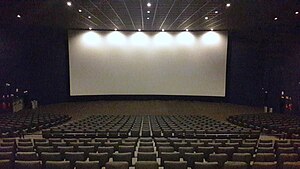
Modern movie house auditorium in Madrid, Spain
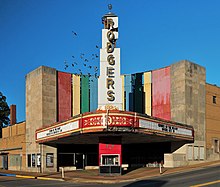

The view from the projectionist'south booth at Ultimate Palace Cinema in Oxford. The projector is displaying the 1997 Universal Pictures logo.

A cinema auditorium in Commonwealth of australia
A cinema (American English language),[1] movie house (British English language),[2] or movie house hall (Indian English language),[3] besides known equally a picture house, the pictures, picture show theater, the argent screen, the big screen or the movies, is a edifice that contains auditoria for viewing films (also chosen movies) for entertainment. Nearly, but non all, theaters are commercial operations catering to the full general public, who attend by purchasing a ticket. Some moving-picture show theaters, however, are operated by non-profit organizations or societies that charge members a membership fee to view films.
The film is projected with a flick projector onto a big project screen at the front of the auditorium while the dialogue, sounds, and music are played through a number of wall-mounted speakers. Since the 1970s, subwoofers have been used for depression-pitched sounds. Since the 2010s, nigh movie theaters have been equipped for digital movie house projection, removing the demand to create and ship a physical film print on a heavy reel.
A swell variety of films are shown at cinemas, ranging from animated films to blockbusters to documentaries. The smallest movie theaters have a single viewing room with a single screen. In the 2010s, virtually movie theaters had multiple screens. The largest theater complexes, which are chosen multiplexes—a concept developed in Canada in the 1950s — have up to thirty screens. The audience members often sit on padded seats, which in about theaters are assail a sloped floor, with the highest role at the rear of the theater. Picture show theaters frequently sell soft drinks, popcorn, and processed, and some theaters sell hot fast food. In some jurisdictions, movie theaters can exist licensed to sell alcoholic drinks.
Terminology [edit]
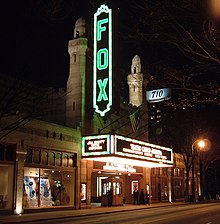
The Fox Theater in Atlanta has an sometime-fashioned neon sign.

A cinema may too be referred to as a movie house, motion-picture show business firm, film theater, cinema or picture house. In the U.s., theater has long been the preferred spelling, while in the UK, Commonwealth of australia, Canada and elsewhere it's theatre.[four]
Even so, some United states of america theaters opt to apply the British spelling in their own names, a practice supported by the National Association of Theatre Owners, while apart from Anglophone Due north America most English language-speaking countries use the term cinema , alternatively spelled and pronounced kinema .[5] [vi] [7] The latter terms, too as their derivative adjectives "cinematic" and "kinematic", ultimately derive from Greek κινῆμα, κινήματος (kinema, kinematos)—"movement", "motion". In the countries where those terms are used, the give-and-take "theatre" is commonly reserved for live functioning venues.
Colloquial expressions, mostly applied to motion pictures and motility pic theaters collectively, include the silver screen (formerly sometimes sheet) and the big screen (contrasted with the smaller screen of a television set gear up). Specific to Due north American term is the movies, while specific terms in the UK are the pictures, the flicks and for the facility itself the flea pit (or fleapit). A screening room is a pocket-size theater, often a individual one, such as for the use of those involved in the production of motion pictures or in a large private residence.
The etymology of the term "movie theater" involves the term "picture", which is a "shortened class of flick in the cinematographic sense" that was showtime used in 1896[8] and "theater", which originated in the "...belatedly 14c., [meaning an] open air identify in aboriginal times for viewing spectacles and plays". The term "theater" comes from the Old French word "theatre", from the 12th century and "...straight from Latin theatrum [which meant] 'play-house, theater; stage; spectators in a theater'", which in plow came from the Greek word "theatron", which meant "theater; the people in the theater; a testify, a spectacle", [or] literally "place for viewing". The utilize of the word "theatre" to mean a "building where plays are shown" dates from the 1570s in the English language.[9]
History [edit]
Precursors [edit]
Movie theatres stand up in a long tradition of theaters that could business firm all kinds of entertainment. Some forms of theatrical entertainment would involve the screening of moving images and tin can be regarded as precursors of moving picture.
In 1799, Étienne-Gaspard "Robertson" Robert moved his Phantasmagorie show to an abandoned cloister near the Place Vendôme in Paris. The eerie environment, with a graveyard and ruins, formed an ideal location for his ghostraising spectacle.
When information technology opened in 1838, The Royal Polytechnic Institution in London became a very popular and influential venue with all kinds of magic lantern shows as an important part of its program. At the principal theatre, with 500 seats, lanternists would make skillful apply of a battery of six large lanterns running on tracked tables to project the finely detailed images of actress large slides on the 648 square anxiety screen. The magic lantern was used to illustrate lectures, concerts, pantomimes and other forms of theatre. Popular magic lantern presentations included phantasmagoria, mechanical slides, Henry Langdon Childe's dissolving views and his chromatrope.[10] [xi]
The earliest known public screening of projected stroboscopic animation was presented by Austrian magician Ludwig Döbler on fifteen January 1847 at the Josephstadt Theatre in Vienna, with his patented Phantaskop. The animated spectacle was part of a well-received testify that sold-out in several European cities during a tour that lasted until the spring of 1848.[12] [13] [14] [xv]
The famous Parisian entertainment venue Le Chat Noir opened in 1881 and is remembered for its shadow plays, renewing the popularity of such shows in France.
Earliest motion moving picture screening venues [edit]
The primeval public pic screenings took place in existing (vaudeville) theatres and other venues that could exist darkened and comfortably house an audition.

Émile Reynaud screened his Pantomimes Lumineuses animated movies from 28 October 1892 to March 1900 at the Musée Grévin in Paris, with his Théâtre Optique system. He gave over 12,800 shows to a total of over 500,000 visitors, with programs including Pauvre Pierrot and Autour d'une cabine.[16] [17]
Thomas Edison initially believed film screening would not be as viable commercially as presenting films in peep boxes, hence the film apparatus that his company would first exploit became the kinetoscope. A few public demonstrations occurred since 9 May 1893, before a first public Kinetoscope parlor was opened on fourteen April 1894, by the Holland Bros. in New York City at 1155 Broadway, on the corner of 27th Street. This can be regarded every bit the first commercial move picture firm. The venue had 10 machines, fix in parallel rows of v, each showing a different movie. For 25 cents a viewer could see all the films in either row; half a dollar gave admission to the entire pecker.[xviii]
The Eidoloscope, devised by Eugene Augustin Lauste for the Latham family unit, was demonstrated for members of the press on 21 April 1895 and opened to the paying public on 20 May, in a lower Broadway store with films of the Griffo-Barnett prize battle fight, taken from Madison Foursquare Garden's roof on 4 May.[19]
Max Skladanowsky and his brother Emil demonstrated their move pictures with the Bioscop in July 1895 at the Gasthaus Sello in Pankow (Berlin). This venue was later, at least since 1918, exploited as the full-time picture palace Pankower Lichtspiele and between 1925 and 1994 as Tivoli.[20] The first sure commercial screenings by the Skladanowsky brothers took place at the Wintergarten in Berlin from 1 to 31 Nov 1895.[21]
The offset commercial, public screening of films made with Louis and Auguste Lumière's Cinématographe took place in the basement of Salon Indien du Thou Café in Paris on 28 December 1895.
Early dedicated movie theatres [edit]

During the first decade of motion pictures, the demand for movies, the amount of new productions, and the average runtime of movies, all kept increasing, and at some stage it was feasible to have theatres that would no longer plan alive acts, but but movies.

Claimants for the title of the earliest cinema include the Eden Theatre in La Ciotat, where L'Arrivée d'un train en gare de La Ciotat was screened on 21 March 1899. The theatre airtight in 1995 just re-opened in 2013.[22]
L'Idéal Cinéma in Aniche (France), built in 1901 equally l'Hôtel du Syndicat CGT, showed its beginning pic on 23 November 1905. The cinema was closed in 1977 and the building was demolished in 1993. The "Centre Culturel Claude Berri" was built in 1995; it integrates a new cinema ( the Idéal Cinéma Jacques Tati).[23] [24]
In the United States, many small and simple theatres were set up, usually in converted storefronts. They typically charged five cents for access, and thus became known as nickelodeons. This type of theatre flourished from about 1905 to circa 1915.[ commendation needed ]
The Korsør Biograf Teater, in Korsør, Kingdom of denmark, opened in August 1908 and is the oldest known moving-picture show theatre still in continuous operation.[25]

Design [edit]


Interior of a 1950s-style fine arts picture palace auditorium. A depression pitch viewing floor is used.
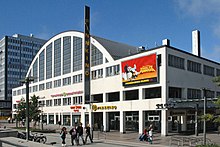

A typical raked (sloped) flooring for a movie auditorium, which gives all viewers a clear view of the screen.
Traditionally a flick theater, like a stage theater, consists of a single auditorium with rows of comfy padded seats, too equally a foyer area containing a box office for buying tickets. Movie theaters also often have a concession correspond buying snacks and drinks within the theater's lobby. Other features included are picture posters, arcade games and washrooms. Stage theaters are sometimes converted into moving picture theaters by placing a screen in front of the stage and adding a projector; this conversion may be permanent, or temporary for purposes such as showing arthouse fare to an audience accustomed to plays. The familiar characteristics of relatively low admission and open up seating can be traced to Samuel Roxy Rothafel, an early picture palace impresario. Many of these early theaters incorporate a balcony, an elevated level beyond the auditorium above the theater's rearmost seats. The rearward primary flooring "loge" seats were sometimes larger, softer, and more than widely spaced and sold for a college toll. In conventional low pitch viewing floors the preferred seating system is to use staggered rows. While a less efficient employ of flooring infinite this allows a somewhat improved sight line between the patrons seated in the next row toward the screen, provided they do not lean toward one another.
"Stadium seating", popular in modern multiplexes, actually dates back to the 1920s. The 1922 Princess Theatre in Honolulu, Hawaii featured "stadium seating", sharply raked rows of seats extending from in front of the screen back towards the ceiling. It gives patrons a clear sight line over the heads of those seated in front of them. Modern "stadium seating" was utilized in IMAX theaters, which have very tall screens, beginning in the early 1970s.
Rows of seats are divided by one or more aisles so that in that location are seldom more than twenty seats in a row. This allows easier access to seating, equally the space between rows is very narrow. Depending on the bending of rake of the seats, the aisles have steps. In older theaters, aisle lights were oftentimes built into the end seats of each row to help patrons discover their way in the dark. Since the appearance of stadium theaters with stepped aisles, each step in the aisles may be outlined with pocket-size lights to forestall patrons from tripping in the darkened theater. In picture theaters, the auditorium may as well have lights that get to a low level, when the movie is going to begin. Theaters often have booster seats for children and other curt people to put on the seat, to sit college, for a better view. Many modern theaters have accessible seating areas for patrons in wheelchairs. See also luxury screens beneath.
Multiplexes and megaplexes [edit]
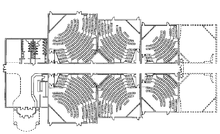
Instance of a Multiplex layout
Canada was the first state in the world to accept a ii-screen theater. The Elgin Theatre in Ottawa, Ontario became the start venue to offer two movie programs on different screens in 1957 when Canadian theater-owner Nat Taylor converted the dual screen theater into one capable of showing two different movies simultaneously. Taylor is credited by Canadian sources as the inventor of the multiplex or cineplex; he later founded the Cineplex Odeon Corporation, opening the 18-screen Toronto Eaton Centre Cineplex, the earth's largest at the time, in Toronto, Ontario.[26] In the United states of america, Stanley Durwood of American Multi-Movie theatre (now AMC Theatres) is credited as pioneering the multiplex in 1963 after realizing that he could operate several attached auditoriums with the same staff needed for one through conscientious management of the start times for each moving picture. Ward Parkway Heart in Kansas City, Missouri had the commencement multiplex picture palace in the United States.
Since the 1960s, multiple-screen theaters have go the norm, and many existing venues accept been retrofitted so that they have multiple auditoriums. A single vestibule area is shared amid them. In the 1970s, many large 1920s picture palaces were converted into multiple screen venues past dividing their large auditoriums, and sometimes even the stage space, into smaller theaters. Because of their size, and civilities like plush seating and extensive nutrient/beverage service, multiplexes and megaplexes draw from a larger geographic surface area than smaller theaters. As a rule of thumb, they pull audiences from an 8 to 12-mile radius, versus a three to five-mile radius for smaller theaters (though the size of this radius depends on population density).[27] As a result, the customer geography expanse of multiplexes and megaplexes typically overlaps with smaller theaters, which face threat of having their audience siphoned past bigger theaters that cut a wider swath in the movie-going landscape.
In most markets, almost all single-screen theaters (sometimes referred to as a "Uniplex") accept gone out of business; the ones remaining are generally used for arthouse films, e.g. the Crest Theatre[28] in downtown Sacramento, California, pocket-sized-calibration productions, motion-picture show festivals or other presentations. Because of the late evolution of multiplexes, the term "movie theatre" or "theater" may refer either to the whole complex or a single auditorium, and sometimes "screen" is used to refer to an auditorium. A popular picture show may be shown on multiple screens at the same multiplex, which reduces the choice of other films but offers more pick of viewing times or a greater number of seats to accommodate patrons. Ii or 3 screens may be created by dividing up an existing cinema (every bit Durwood did with his Roxy in 1964), just newly built multiplexes commonly accept at least half dozen to eight screens, and often as many as twelve, fourteen, 16 or even eighteen.
Although definitions vary, a big multiplex with 20 or more screens is ordinarily called a "megaplex". However, in the United kingdom of great britain and northern ireland, this was a brand name for Virgin Cinema (afterward UGC). The start megaplex is generally considered to be the Kinepolis in Brussels, Kingdom of belgium, which opened in 1988 with 25 screens and a seating capacity of 7,500. The kickoff theater in the U.South. built from the ground up equally a megaplex was the AMC Grand 24 in Dallas, Texas, which opened in May 1995, while the kickoff megaplex in the U.S.-based on an expansion of an existing facility was Studio 28 in One thousand Rapids, Michigan, which reopened in November 1988 with 20 screens and a seating capacity of half-dozen,000.
Drive-in [edit]

A bulldoze-in moving-picture show theater is an outdoor parking expanse with a screen—sometimes an inflatable screen—at one end and a projection booth at the other. Moviegoers bulldoze into the parking spaces which are sometimes sloped up at the front to requite a more direct view of the movie screen. Movies are usually viewed through the automobile windscreen (windshield) although some people prefer to sit on the bonnet (hood) of the car. Some may besides sit in the trunk (dorsum) of their auto if space permits. Sound is either provided through portable loudspeakers located by each parking space, or is broadcast on an FM radio frequency, to be played through the car's stereo system. Considering of their outdoor nature, drive-ins normally but operate seasonally, and after sunset. Bulldoze-in movie theaters are mainly plant in the United States,[ citation needed ] where they were especially popular in the 1950s and 1960s. One time numbering in the thousands, about 400 remain in the U.Southward. today. In some cases, multiplex or megaplex theaters were built on the sites of old drive-in theaters.
Other venues [edit]

1967 Bedford mobile cinema
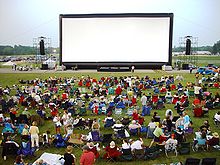
Some outdoor movie theaters are just grassy areas where the audience sits upon chairs, blankets or even in hot tubs, and sentry the movie on a temporary screen, or even the wall of a building. Colleges and universities have oftentimes sponsored movie screenings in lecture halls. The formats of these screenings include 35 mm, sixteen mm, DVD, VHS, and even 70 mm in rare cases. Some alternative methods of showing movies have been popular in the past. In the 1980s the introduction of VHS cassettes made possible video-salons, pocket-size rooms where visitors viewed movies on a big Tv. These establishments were peculiarly popular in the Soviet Wedlock, where official distribution companies were slow to adapt to changing demand, and so movie theaters could non prove popular Hollywood and Asian films.
In 1967, the British government launched seven custom-congenital mobile cinema units for apply equally office of the Ministry of Engineering campaign to raise standards. Using a very futuristic look, these 27-seat cinema vehicles were designed to attract attention. They were built on a Bedford SB3 chassis with a custom Coventry Steel Caravan extruded aluminum body. Movies are also ordinarily shown on airliners in flying, using big screens in each cabin or smaller screens for each group of rows or each individual seat; the airline company sometimes charges a fee for the headphones needed to hear the film's sound. In a similar fashion, movies are sometimes also shown on trains, such as the Machine Railroad train.
The smallest purpose-built cinema is the Cabiria Cine-Cafe which measures 24 chiliad2 (258.3 ft²) and has a seating capacity of eighteen. It was built by Renata Carneiro Agostinho da Silva (Brazil) in Brasília DF, Brazil in 2008. It is mentioned in the 2010 Guinness World Records. The World's smallest solar-powered mobile cinema is Sol Cinema in the United kingdom of great britain and northern ireland. Touring since 2010 the cinema is actually a converted 1972 caravan. It seats 8–10 at a fourth dimension. In 2015 information technology featured in a Lenovo advert for the launch of a new tablet. The Bell Museum of Natural History in Minneapolis, Minnesota has recently begun summer "cycle-ins", inviting simply pedestrians or people on bicycles onto the grounds for both live music and movies. In various Canadian cities, including Toronto, Calgary, Ottawa and Halifax, al-fresco movies projected on the walls of buildings or temporarily erected screens in parks operate during the Summer and cater to a pedestrian audition. The New Parkway Museum in Oakland, California replaces general seating with couches and java tables, likewise as having a total eating place card instead of full general movie theater concessions such as popcorn or candy.[ commendation needed ]
3D [edit]

3D film is a system of presenting picture images so that they appear to the viewer to be three-dimensional. Visitors usually infringe or keep special glasses to wear while watching the pic. Depending on the organisation used, these are typically polarized spectacles. Three-dimensional movies apply two images channeled, respectively, to the right and left eyes to simulate depth by using iii-D glasses with red and bluish lenses (anaglyph), polarized (linear and round), and other techniques. 3-D glasses deliver the proper prototype to the proper eye and make the epitome appear to "pop-out" at the viewer and even follow the viewer when he/she moves then viewers relatively come across the same image.
The earliest 3D movies were presented in the 1920s. There take been several prior "waves" of 3D moving picture distribution, most notably in the 1950s when they were promoted as a way to offer audiences something that they could not run across at dwelling house on television receiver. Still the procedure faded quickly and as withal has never been more than a periodic novelty in moving-picture show presentation. The "golden era" of 3D film began in the early on 1950s with the release of the starting time color stereoscopic feature, Bwana Devil.[30] The film starred Robert Stack, Barbara Britton and Nigel Bruce. James Mage was an early pioneer in the 3D craze. Using his 16 mm 3D Bolex arrangement, he premiered his Triorama program in February 1953 with his 4 shorts: Sunday In Stereo, Indian Summertime, American Life, and This is Bolex Stereo.[31] 1953 saw 2 groundbreaking features in 3D: Columbia'southward Human being in the Dark and Warner Bros. House of Wax, the first 3D feature with stereophonic sound. For many years, near three-D movies were shown in entertainment parks and fifty-fifty "4-D" techniques take been used when certain effects such every bit spraying of water, movement of seats, and other effects are used to simulate deportment seen on the screen. The first decline in the theatrical 3D craze started in August and September 1953.
In 2009, picture show exhibitors became more interested in 3D pic. The number of 3D screens in theaters is increasing. The RealD company expects xv,000 screens worldwide in 2010. The availability of 3D movies encourages exhibitors to prefer digital cinema and provides a way for theaters to compete with home theaters. One incentive for theaters to prove 3D films is that although ticket sales have declined, revenues from 3D tickets have grown.[32] In the 2010s, 3D films became popular again. The IMAX 3D system and digital 3D systems are used (the latter is used in the animated movies of Disney/Pixar).
The RealD 3D system works past using a single digital projector that swaps back and forth between the images for eyes. A filter is placed in front end of the projector that changes the polarization of the light coming from the projector. A silver screen is used to reflect this lite back at the audience and reduce loss of brightness. In that location are iv other systems bachelor: Volfoni, Master Image, XpanD and Dolby 3D.
When a system is used that requires inexpensive 3D glasses, they can sometimes exist kept by the patron. Most theaters have a fixed cost for 3D, while others charge for the glasses, but the latter is uncommon (at least in the U.s.). For example, in Pathé theaters in the netherlands the extra fee for watching a 3D film consists of a fixed fee of €i.50, and an optional fee of €1 for the glasses.[33] Holders of the Pathé Unlimited Gilt pass (meet besides beneath) are supposed to bring along their own spectacles; one pair, supplied yearly, more robust than the regular type, is included in the cost.
IMAX [edit]
IMAX is a organization using picture with more x times the frame size of a 35 mm film to produce image quality far superior to conventional pic. IMAX theaters apply an oversized screen every bit well as special projectors. Invented by a Canadian company, the first permanent IMAX theater was at Ontario Place in Toronto, Canada. Until 2016, visitors to the IMAX picture palace attached to the National Science and Media Museum in Bradford, W Yorkshire, England, Britain, could observe the IMAX projection berth via a glass rear wall and watch the big format films being loaded and projected.[34] At that place is also an IMAX theater in the Museum of science in Boston Massachusetts. The biggest movie theater screen in the world in Darling Harbour, Sydney Australia is an IMAX theater.[35] [36]
Programming [edit]

Non-movie-theater screening: moving picture in a culture club in Germany
Pic theaters may be classified by the type of movies they show or when in a flick's release procedure they are shown:
- Offset-run theater: A theater that runs primarily mainstream film fare from the major film companies and distributors, during the initial new release menses of each film.
- Second-run or discount theater: A theater that runs films that have already shown in the first-run theaters and presented at a lower ticket cost. (These are sometimes known as dollar theaters or "cheap seats".) This form of movie theater is diminishing in viability attributable to the increasingly shortened intervals before the films' abode video release, chosen the "video window".
- Repertoire/repertory theater or arthouse: A theater that presents more alternative and fine art films as well as 2nd-run and classic films (often known as an "independent movie theatre" in the UK).
- An adult movie theater or sex theater specializes in showing pornographic movies. Such movies are rarely shown in other theaters. Come across also Golden Age of Porn. Since the widespread availability of pornographic films for home viewing on VHS in the 1980s and 1990s, the DVD in the 1990s, and the Blu-ray disc in the 2000s, there are far fewer adult motion-picture show theaters.
- IMAX theaters tin can show conventional movies, but the major benefits of the IMAX arrangement are only available when showing movies filmed using it. While a few mainstream feature films accept been produced in IMAX, IMAX movies are oft documentaries featuring spectacular natural scenery, and may be limited to the 45-minute length of a single reel of IMAX picture show.
Presentation [edit]


Unremarkably in the 2010s, an admission is for i feature picture show. Sometimes two feature films are sold equally one access (double characteristic), with a interruption in between. Separate admission for a short subject is rare; it is either an actress before a feature film or part of a series of brusk films sold equally one admission (this mainly occurs at film festivals). (Run across also anthology motion-picture show.) In the early decades of "talkie" films, many motion-picture show theaters presented a number of shorter items in add-on to the feature moving picture. This might include a newsreel, live-action comedy brusk films, documentary short films, musical short films, or drawing shorts (many archetype cartoons series such equally the Looney Tunes and Mickey Mouse shorts were created for this purpose). Examples of this kind of programming are available on certain DVD releases of two of the near famous films starring Errol Flynn as a special characteristic arrangement designed to recreate that kind of filmgoing experience while the PBS serial, Matinee at the Bijou, presented the equivalent content. Some theaters ran on continuous showings, where the aforementioned items would repeat throughout the twenty-four hour period, with patrons arriving and departing at any time rather than having distinct entrance and leave cycles. Newsreels gradually became obsolete by the 1960s with the rise of television news, and about fabric at present shown prior to a characteristic motion picture is of a commercial or promotional nature (which usually include "trailers", which are advertisements for films and commercials for other consumer products or services).
A typical modernistic theater presents commercial advertising shorts, then movie trailers, and then the characteristic film. Advertised kickoff times are usually for the entire programme or session, not the feature itself;[37] thus people who want to avoid commercials and trailers would opt to enter later. This is easiest and causes the least inconvenience when it is non crowded or i is not very choosy about where ane wants to sit. If i has a ticket for a specific seat (encounter below) one is formally assured of that, but it is yet inconvenient and agonizing to notice and claim it during the commercials and trailers, unless it is well-nigh an alley. Some movie theaters have some kind of break during the presentation, particularly for very long films. There may also be a break betwixt the introductory material and the feature. Some countries such as the Netherlands accept a tradition of incorporating an intermission in regular feature presentations, though many theaters accept at present abandoned that tradition,[38] while in North America, this is very rare and usually limited to special circumstances involving extremely long movies. During the closing credits many people leave, merely some stay until the stop. Usually the lights are switched on after the credits, sometimes already during them. Some films evidence mid-credits scenes while the credits are rolling, which in comedy films are often bloopers and outtakes, or post-credits scenes, which typically set the audition for a sequel.
Until the multiplex era, prior to showtime, the screen in some theaters would exist covered by a curtain, in the style of a theater for a play. The pall would be fatigued for the feature. It is common practice in Australia for the curtain to cover part of the screen during advertising and trailers, then exist fully drawn to reveal the full width of the screen for the main feature. Some theaters, lacking a drapery, filled the screen with slides of some form of abstruse art prior to the start of the picture. Currently, in multiplexes, theater chains often characteristic a continuous slideshow between showings featuring a loop of movie trivia, promotional material for the theater bondage (such as encouraging patrons to purchase drinks, snacks and popcorn, gift vouchers and grouping rates, or other vestibule retail offers), or advertizement for local and national businesses. Advertisements for Fandango and other convenient methods of purchasing tickets is often shown. Also prior to showing the motion picture, reminders, in varying forms would exist shown concerning theater etiquette (no smoking, no talking, no littering, removing crying babies, etc.) and in recent years, added reminders to silence mobile phones as well equally warning concerning movie piracy with camcorders ("camming").
Some well-equipped theaters take "interlock" projectors which allow two or more projectors and sound units to be run in unison by connecting them electronically or mechanically. This set up tin can exist used to projection two prints in sync (for dual-projector 3-D) or to "interlock" one or more than audio tracks to a single moving picture. Sound interlocks were used for stereophonic sound systems before the advent of magnetic film prints.[39] Fantasound (developed by RCA in 1940 for Disney'south Fantasia) was an early interlock system. Likewise, early on stereophonic films such every bit This Is Cinerama and House of Wax utilized a separate, magnetic oxide-coated flick to reproduce upwards to half dozen or more tracks of stereophonic sound. Datasat Digital Entertainment, purchaser of DTS's cinema division in May 2008, uses a time lawmaking printed on and read off of the moving picture to synchronize with a CD-ROM in the audio track, assuasive multi-channel soundtracks or foreign language tracks. This is non considered a projector interlock, however.
This practice is most common with blockbuster movies. Muvico Theaters, Royal Amusement Group, Pacific Theatres and AMC Theatres are some theaters that interlock films.[40]
Live broadcasting to movie theaters [edit]
Sometimes picture show theaters provide digital projection of a live broadcast of an opera, concert, or other performance or result. For example, there are regular alive broadcasts to motion-picture show theaters of Metropolitan Opera performances, with additionally limited repeat showings. Admission prices are often more than twice the regular picture show theater admission prices.
Pricing and admission [edit]



A theatre-goer enjoys a show
In order to obtain admission to a cinema, the prospective theater-goer must usually buy a ticket from the box office, which may be for an capricious seat ("open" or "free" seating, start-come, first-served) or for a specific 1 (allocated seating).[42] As of 2015, some theaters sell tickets online or at automated kiosks in the theater entrance hall. Pic theaters in N America generally have open seating. Cinemas in Europe tin can take free seating or numbered seating. Some theaters in Mexico offering numbered seating, in detail, Cinepolis VIP. In the case of numbered seating systems the attendee tin can frequently selection seats from a video screen. Sometimes the attendee cannot run across the screen and has to make a selection based on a verbal description of the still bachelor seats. In the case of gratis seats, already seated customers may exist asked by staff to motion one or more places for the benefit of an arriving couple or group wanting to sit together.
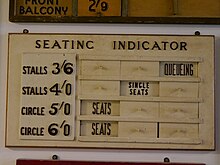
For 2013, the average toll for a movie ticket in the United states of america was $8.13.[43] The toll of a ticket may exist discounted during off-tiptop times e.g. for matinees, and higher at busy times, typically evenings and weekends. In Commonwealth of australia, Canada and New Zealand, when this exercise is used, it is traditional to offer the lower prices for Tuesday for all showings, one of the slowest days of the week in the movie theater business, which has led to the nickname "cheap Tuesday".[44] Sometimes tickets are cheaper on Mon, or on Dominicus morn. Nigh all pic theaters employ economical toll discrimination: tickets for youth, students, and seniors are typically cheaper. Large theater chains, such as AMC Theaters, as well own smaller theaters that show "2d runs" of popular films, at reduced ticket prices. Motion picture theaters in India and other developing countries apply price discrimination in seating arrangement: seats closer to the screen cost less, while the ones farthest from the screen cost more. Movie theatres in India are as well practicing safety guidelines and precautions afterward 2020.
In the Us, many picture theater chains sell discounted passes, which can be exchanged for tickets to regular showings. These passes are traditionally sold in bulk to institutional customers and also to the full general public at Bulktix.com.[45] Some passes provide substantial discounts from the price of regular access, especially if they carry restrictions. Mutual restrictions include a waiting flow after a picture show'southward release before the pass can exist exchanged for a ticket or specific theaters where a pass is ineligible for access.
Some movie theaters and chains sell monthly passes for unlimited entrance to regular showings. Cinemas in Thailand take a brake of one viewing per film. The increasing number of 3D movies, for which an additional fee is required, somewhat undermines the concept of unlimited archway to regular showings, in particular if no second version is screened, except in the cases where 3D is included. Some adult theaters sell a day pass, either as standard ticket, or equally an option that costs a footling more a unmarried admission. As well for some film festivals, a pass is sold for unlimited archway. Disbelieve theaters show films at a greatly discounted charge per unit, all the same, the films shown are by and large films that have already run for many weeks at regular theaters and thus are no longer a major draw, or films which flopped at the box office and thus have already been removed from showings at major theaters in order to costless up screens for films that are a meliorate box office draw.
Luxury screens [edit]
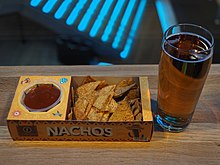
Some movie theaters in Finland sell alcohol to take along to the flick itself in select showings. Such showings are always adults-but, regardless of the rating of the film.
Some cinemas in urban center centers offering luxury seating with services like free refills of soft drinks and popcorn, a bar serving beer, wine and liquor, reclining leather seats and service bells.[46] Cinemas must have a liquor license to serve alcohol.[47] The Vue Cinema and CGV Cinema concatenation is a good example of a large-scale offer of such a service, called "Gold Class" and similarly, ODEON, Britain'southward largest cinema concatenation, and 21 Cineplex, Indonesia's largest cinema chain, take gallery areas in some of their bigger cinemas where at that place is a split up vestibule surface area with a bar and unlimited snacks.[48] [49]
Age restrictions [edit]

These ratings are from the revised Taiwan movement film rating system which took event in Oct 2015.
In Finland, in add-on to the historic period limits, there are film content icons on the basis of which the age limit is determined. From left to right: violence, sexual activity, fright and substance abuse.
Access to a moving picture may also be restricted by a motility picture rating system, typically due to depictions of sex activity, nudity or graphic violence. According to such systems, children or teenagers below a certain age may be forbidden access to theaters showing certain movies, or simply admitted when accompanied by a parent or other adult. In some jurisdictions, a rating may legally impose these historic period restrictions on movie theaters. Where movie theaters do not accept this legal obligation, they may enforce restrictions on their own. Accordingly, a movie theater may either not exist allowed to program an unrated moving picture, or voluntarily refrain from that.
Revenue [edit]
Moving-picture show studios/film distributors in the US traditionally bulldoze hard bargains entitling them to as much every bit 100% of the gross ticket revenue during the first weeks (and and so the rest changes in 10% increments in favor of exhibitors at intervals that vary from film to moving picture).[fifty] Film exhibition has seen a ascension in its development with video consolidation also as DVD sales, which over the past two decades is the biggest earner in revenue. According to The Gimmicky Hollywood Moving picture Industry, Philip Drake states that box office takings currently account for less than a quarter of total revenues and take become increasingly "front loaded", earning the bulk of receipts in the opening two weeks of exhibition, meaning that films need to make an most instant impact in guild to avoid being dropped from screens by exhibitors. Essentially, if the film does not succeed in the offset few weeks of its inception, information technology will most likely fail in its attempt to gain a sustainable corporeality of acquirement and thus being taken out from motion picture theaters. Furthermore, higher-budget films on the "opening weekend", or the 3 days, Friday to Lord's day, can signify how much revenue it will bring in, non just to America, simply as well as overseas. It may as well determine the price in distribution windows through domicile video and idiot box.[51]
In Canada, the total operating revenue in the picture palace manufacture was $1.7 billion in 2012, an eight.4% increase from 2010. This increase was mainly the effect of growth in box office and concession acquirement. Combined, these deemed for 91.ix% of full industry operating acquirement.[52] In the US, the "...number of tickets sold fell nearly 11% between 2004 and 2013, according to the report, while box office acquirement increased 17%" due to increased ticket prices.[53]
New forms of competition [edit]
I reason for the refuse in ticket sales in the 2000s is that "domicile-entertainment options [are] improving all the time— whether streamed movies and television, video games, or mobile apps—and studios releasing fewer movies", which means that "people are less likely to caput to their local multiplex".[53] This reject is not something that is contempo. Information technology has been observed since the 1950s when television became widespread amidst working-class homes. As the years went on, home media became more popular, and the decline continued. This refuse continues until this day.[54] A Pew Media survey from 2006 plant that the relationship between movies watched at abode versus at the moving picture theater was in a five to one ratio and 75% of respondents said their preferred fashion of watching a moving-picture show was at dwelling, versus 21% who said they preferred to become to a theater.[55] In 2014, it was reported that the exercise of releasing a moving picture in theaters and via on-demand streaming on the aforementioned day (for selected films) and the rising in popularity of the Netflix streaming service has led to concerns in the movie theater manufacture.[56] Another source of competition is television, which has "...stolen a lot of cinema's best tricks – like adept production values and top tier actors – and brought them into people's living rooms".[56] Since the 2010s, one of the increasing sources of competition for moving-picture show theaters is the increasing buying by people of dwelling house theater systems which can brandish loftier-resolution Blu-ray disks of movies on big, widescreen apartment-screen TVs,[56] with five.1 surround audio and a powerful subwoofer for low-pitched sounds.
Ticket toll uniformity [edit]

Admission ticket for the premier of the movie A Viszkis
The relatively strong uniformity of picture show ticket prices, peculiarly in the U.South., is a common economic science puzzle, because conventional supply and need theory would suggest higher prices for more pop and more expensive movies, and lower prices for an unpopular "bomb" or for a documentary with less audience appeal.[57] Different seemingly similar forms of entertainment such as rock concerts, in which a popular performer's tickets cost much more than an unpopular performer'southward tickets, the need for movies is very difficult to predict alee of fourth dimension. Indeed, some films with major stars, such every bit Gigli (which starred the then-supercouple of Ben Affleck and Jennifer Lopez), have turned out to be box-part bombs, while low-budget films with unknown actors accept become blast hits (east.thousand., The Blair Witch Project). The need for films is usually determined from ticket auction statistics afterward the movie is already out. Uniform pricing is therefore a strategy to cope with unpredictable need. Historical and cultural factors are sometimes likewise cited.[58]
Ticket check [edit]
In some movie theater complexes, the theaters are arranged such that tickets are checked at the entrance into the unabridged plaza, rather than before each theater. At a theater with a sold-out show there is often an additional ticket check, to make sure that everybody with a ticket for that show tin can observe a seat. The lobby may be before or after the ticket bank check.
Controversies [edit]
- Advertizing: Some moviegoers complain about commercial advertizing shorts played before films, arguing that their absence used to be one of the chief advantages of going to a moving picture theater. Other critics such every bit Roger Ebert have expressed concerns that these advertisements, plus an excessive number of moving-picture show trailers, could lead to pressure to restrict the preferred length of the feature films themselves to facilitate playing schedules. So far, the theater companies have typically been highly resistant to these complaints, citing the need for the supplementary income. Some chains like Famous Players and AMC Theatres have compromised with the commercials restricted to being shown before the scheduled beginning time for the trailers and the feature film. Private theaters inside a chain besides sometimes prefer this policy.[59]
- Loudness: Another major contempo business concern is that the dramatic improvements in stereo sound systems and in subwoofer systems have led to cinemas playing the soundtracks of films at unacceptably high volume levels. Usually, the trailers are presented at a very high sound level, presumably to overcome the sounds of a busy crowd. The audio is not adjusted downward for a sparsely occupied theater. Book is normally adjusted based on the projectionist'southward judgment of a high or low omnipresence. The movie is normally shown at a lower book level than the trailers. In response to audience complaints, a manager at a Cinemark theater in California explained that the studios set up trailer sound levels, not the theater.[ commendation needed ]
- Copyright piracy: In contempo years, cinemas have started to evidence warnings before the movie starts confronting using cameras and camcorders during the movie (camming). Some patrons record the motion picture in guild to sell "bootleg" copies on the black market place. These warnings threaten customers with beingness removed from the cinema and arrested past the police. This example was shown at cinemas in the United Kingdom:
Y'all are not permitted to employ whatever camera or recording equipment in this cinema. This will be treated as an attempt to breach copyright. Whatever person doing so can be ejected and such articles may be confiscated by the constabulary. We ask the audience to exist vigilant confronting any such activity and study whatever matters arousing suspicion to movie house staff. Thank you.
Some theaters (including those with IMAX stadiums) have detectors at the doors to pick up recording smugglers. At particularly anticipated showings, theaters may employ night vision equipment to notice a working camera during a screening. In some jurisdictions this is illegal unless the exercise has been appear to the public in advance.[sixty]
- Crowd control: As movie theaters accept grown into multiplexes and megaplexes, crowd command has go a major business organization. An overcrowded megaplex can be rather unpleasant, and in an emergency tin exist extremely dangerous (indeed, "shouting fire in a crowded theater" is the standard instance of the limits to free speech, because it could cause a deadly panic). Therefore, all major theater chains accept implemented crowd control measures. The well-nigh well-known measure is the ubiquitous holdout line, which prevents ticket holders for the adjacent showing of that weekend's most pop motion picture from entering the building until their particular auditorium has been cleared out and cleaned. Since the 1980s, some theater chains (especially AMC Theatres) have developed a policy of co-locating their theaters in shopping centers (as opposed to the old do of building stand-solitary theaters).[61] In some cases, lobbies and corridors cannot agree as many people as the auditoriums, thus making holdout lines necessary. In turn, ticket holders may exist enticed to shop or swallow while stuck outside in the holdout line. Still, given the fact that rent is based on floor expanse, the practice of having a smaller lobby is somewhat understandable.[62]

A bag of popcorn from the Plaza Theater in Atlanta, Georgia.
- Refunds: Near movie house companies event refunds if in that location is a technical error such equally a power outage that stops people from seeing a moving picture. Refunds may be offered during the initial 30 minutes of the screening. The New York Times reported that some audience members walked out of Terrence Malick'due south film Tree of Life and asked for refunds.[63] At AMC theaters, "...patrons who sat through the entire film and so decided they wanted their coin back were out of luck, as AMC'due south policy is to only offer refunds 30 minutes into a screening. The same goes for Landmark, an independent pic chain... whose policy states, 'If a moving-picture show is non what is expected… and the feature is viewed less than thirty minutes a refund can be candy for you at the box part.'"[63]
- Snack prices: The price of soft drinks and candy at theaters is typically significantly higher than the toll of those items at any other place. Popcorn prices can also be exorbitant. It has been "...estimated that film theaters make an 85% profit at the concessions stand on overpriced soda, candy, nachos, hot dogs and, of grade, popcorn. Movie-theater popcorn has been chosen one of America's biggest rip-offs, with a retail price of nine times what information technology costs to brand."[64]
Cinema and movie theater chains [edit]
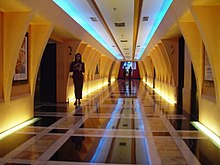
Hallway of MPX Grande, a defunct pic theater in Pasaraya Blok M, Djakarta.
In Africa, Ster-Kinekor has the largest market share in South Africa. Nu Metro Cinemas is another cinema chain in Southward Africa.
In Due north America, the National Clan of Theatre Owners (NATO) is the largest exhibition trade organization in the world. According to their figures, the top iv bondage represent well-nigh half of the theater screens in North America. In Canada, Cineplex Entertainment is past far the largest player with 161 locations and 1,635 screens.
In the United States, the studios once controlled many theaters, but after the appearance of Mr. Smith Goes to Washington, Congress passed the Neely Anti-Block Booking Human activity, which eventually bankrupt the link betwixt the studios and the theaters. Now, the top three bondage in the U.S. are Regal Entertainment Group, AMC Entertainment Inc and Cinemark Theatres. In 1995, Carmike was the largest chain in the United States- now, the major bondage include AMC Entertainment Inc – five,206 screens in 346 theaters,[65] Cinemark Theatres – 4,457 screens in 334 theaters,[66] Landmark Theatres – 220 screens in 54 theaters,[67] Marcus Theatres – 681 screens in 53 theaters.[68] National Amusements – 409 screens in 32 theaters[68] and Regal Entertainment Group – vii,334 screens in 588 cinemas.[69] In 2015 the Us had a total of 40,547 screens.[70] In United mexican states, the major chains are Cinepolis and Cinemex.
In South America, Argentine bondage include Hoyts, Village Cinemas, Cinemark and Showcase Cinemas. Brazilian bondage include Cinemark and Moviecom. Chilean chains include Hoyts and Cinemark. Colombian, Costa Rican, Panamanian and Peruvian bondage include Cinemark and Cinépolis.
In Asia, Wanda Cinemas is the largest exhibitor in China, with ii,700 screens in 311 theaters[71] and with eighteen% of the screens in the country;[72] another major Chinese chain is UA Cinemas. China had a total of 31,627 screens in 2015 and is expected to accept near 40,000 in 2016.[lxx] Hong Kong has AMC Theatres. South korea's CJ CGV as well has branches in China, Indonesia, Myanmar, Turkey, Vietnam, and the United States. In India, PVR Cinemas is a leading cinema operating a chain of 500 screens and CineMAX and INOX are both multiplex bondage. These theatres practice safety guidelines in each cinema halls. Indonesia has the 21 Cineplex and Cinemaxx (As od 2019, renamed as Cinépolis) concatenation. A major Israel theater is Cinema City International. Japanese chains include Toho and Shochiku.
Europe is served by AMC, Cineworld, Vue Cinema and Odeon.
In Oceania (particularly Commonwealth of australia), large chains include Event Cinemas, Village Cinemas, Hoyts Cinemas and Palace Cinemas.
See likewise [edit]
- Movie house etiquette
- Pic poster
- Flick screening
- Home cinema
- Inflatable pic screen
- List of bulldoze-in theaters
- List of picture theaters
- Mini theater
- Picture palace
- Multiplex (movie theater)
- Nickelodeon (picture palace)
- Saturday morning pictures
References [edit]
- ^ "Picture palace definition and meaning – Collins English Dictionary". www.collinsdictionary.com . Retrieved xiv April 2018.
- ^ "cinema – Definition of cinema in English by Oxford Dictionaries". Oxford Dictionaries – English . Retrieved 14 April 2018.
- ^ "movie theatre hall Pregnant in the Cambridge English Dictionary". lexicon.cambridge.org . Retrieved 14 April 2018.
- ^ Originally spelled theatre and teatre (c. 1380), from around 1550 to 1700 or later, the most mutual spelling was theater. Betwixt 1720 and 1750, theater was dropped in British English but was either retained or revived in American English (Oxford English Dictionary, 2nd edition, 2009, CD-ROM: ISBN 9780199563838). Recent dictionaries of American English language list theatre equally a less common variant, e.m., Random House Webster'south Higher Dictionary (1991); The American Heritage Dictionary of the English language Language, quaternary edition (2006); New Oxford American Lexicon, third edition (2010); Merriam-Webster Dictionary (2011).
- ^ Merriam-Webster: kinema—British variant of movie theater Retrieved 21 July 2012.
- ^ Kinema – a periodical for picture show and audiovisual media Retrieved 21 July 2012.
- ^ The Kinema in the Woods—name of cinema in Woodhall Spa Retrieved 21 July 2012.
- ^ "movie | Etymology, origin and meaning of moving picture by etymonline". www.etymonline.com.
- ^ "theatre | Search Online Etymology Dictionary". www.etymonline.com.
- ^ Heard, Mervyn. PHANTASMAGORIA: The Secret History of the Magic Lantern. The Projection Box, 2006
- ^ The Magazine of Science, and Schools of Art - Vol. Iv. 1843. p. 410.
- ^ Allgemeine Theaterzeitung und Originalblatt für Kunst, Literatur, und geselliges Leben (in German). im Bureau der Theaterzeitung. 1847.
- ^ Rossell, Deac. "The Exhibition of Moving Pictures before 1896".
- ^ "ANNO, Die Gegenwart. Politisch-literarisches Tagblatt, 1847-01-18, Seite 4". anno.onb.air-conditioning.at . Retrieved 15 April 2020.
- ^ "ANNO, Österreichisches Morgenblatt; Zeitschrift für Vaterland, Natur und Leben, 1847-02-03, Seite 2". anno.onb.ac.at . Retrieved 15 April 2020.
- ^ "Le Théâtre optique". Archived from the original on 11 November 2008.
- ^ Myrent, Glenn (1989). "Emile Reynaud: First Movement Picture Cartoonist". Flick History. 3 (3): 191–202. JSTOR 3814977.
- ^ The machines were modified so that they did non operate by nickel slot. According to Hendricks (1966), in each row "attendants switched the instruments on and off for customers who had paid their 20-five cents" (p. 13). For more than on the Hollands, see Peter Morris, Embattled Shadows: A History of Canadian Picture palace, 1895–1939 (Montreal and Kingston, Canada; London; and Buffalo, New York: McGill-Queen'due south University Printing, 1978), pp. 6–vii. Morris states that Edison wholesaled the Kinetoscope at $200 per machine; in fact, equally described beneath, $250 seems to have been the most common figure at offset.
- ^ Streible, Dan (xi Apr 2008). Fight Pictures: A History of Battle and Early Cinema. University of California Press. p. 46. ISBN9780520940581 . Retrieved 16 May 2016.
- ^ "BERLIN Tivoli". www.allekinos.com . Retrieved 22 March 2020.
- ^ "Who's Who of Victorian Picture palace". www.victorian-movie house.internet . Retrieved 22 March 2020.
- ^ "World'southward oldest cinema to reopen in French republic'southward La Ciotat". France 24. ix Oct 2013. Retrieved 22 April 2019.
- ^ "Aniche – le Jacques Tati". De la suite dans les images (in French). 2011. Archived from the original on iv July 2013. Retrieved 31 August 2020.
- ^ Dubrulle, Benjamin (26 January 2020). "On vous refait le picture show de l'Idéal-cinéma Jacques-Tati d'Aniche". La Voix du Nord (in French). Retrieved 31 August 2020.
- ^ "Guinness". Korsør Biograf Teater (in Danish). Archived from the original on 31 August 2020. Retrieved 31 August 2020.
- ^ "Nat Taylor | Historica – Dominion". Historica. Archived from the original on 27 September 2011. Retrieved 4 November 2012.
- ^ Marich, Robert (2013) Marketing To Moviegoers: 3rd Edition (2013), SIU Press books, p.295
- ^ "Welcome to the Crest Theatre". Thecrest.com. Retrieved four November 2012.
- ^ "Open air cinemas". Retrieved 21 January 2016.
- ^ Gunzberg, K.50. (1953). "What is Natural Vision?", New Screen Techniques. 55–59.
- ^ "But Like 1927." BoxOffice 7 Feb 1953: 12.
- ^ Walters, Ben. "The Bang-up Leap Forwards." Sight & Sound, 19.3. (2009) pp. 38–41.
- ^ "Je eigen 3D-bril". Pathe.nl. Archived from the original on 20 November 2012. Retrieved four November 2012.
- ^ "IMAX". National Science and Media Museum. Retrieved 1 May 2020.
- ^ Archived at Ghostarchive and the Wayback Automobile: "Inside Darling Harbour iMax Theatre - Sydney - Australia". YouTube.
- ^ "IMAX to be demolished, reborn as the Ribbon". 25 Baronial 2016.
- ^ "The love and loathing of picture palace ads", BBC News website, 23 February 2005
- ^ BoomChicago.nl website Archived 20 Apr 2006 at the Wayback Machine
- ^ Boorstin, Jon (25 March 2016). "On Its 40th Ceremony: Notes on the Making of All the President'due south Men". Los Angeles Review of Books . Retrieved 7 October 2019.
- ^ "Cover Your Eyes! How Harry Guerro Brought the Wildest Old 3-D Movies to the Quad Cinema". www.villagevoice.com. 12 October 2017. Retrieved 7 Oct 2019.
- ^ "Fine Arts Group". Retrieved 21 January 2016.
- ^ "FAQs – Vue Cinemas". Vue Cinemas. Archived from the original on 3 December 2008. Retrieved 21 January 2016.
- ^ "Movie theatre Statistics for 2013". MarketingMovies.net. Archived from the original on 30 March 2014. Retrieved 24 March 2014.
- ^ "First the accusatory vignettes that air earlier the film, and now this". Skirl – Dan Dickinson. ii April 2004. Retrieved 21 January 2016.
- ^ "BulkTix.com – Bulktix.com – Disbelieve Movie Tickets to AMC, Cinemark, Pacific and thousands of movie theaters". Archived from the original on 27 January 2016. Retrieved 21 January 2016.
- ^ "Environment Sound? IMAX? Chardonnay? Motion picture Theaters Look to Alcoholic Beverages". Wine Spectator . Retrieved seven October 2019.
- ^ "Licence types and trading hours". sitefinitycms-staging . Retrieved seven October 2019.
- ^ Swindale, Rachael (8 June 2019). "Want to save coin at the movies? Hither'southward the full picture". The Guardian. ISSN 0261-3077. Retrieved 7 October 2019.
- ^ Young, Graham (2 June 2018). "Start expect effectually Britain's biggest luxury cinema in Birmingham". birminghammail . Retrieved 7 October 2019.
- ^ Darren Filson, David Switzer and Portia Besocke, "At the movies: the economics of exhibition contracts," Economic Enquiry 43, no. 2 (April 2005): 354–370.
- ^ McDonald, Paul; Wasko, Janet (2008). The Contemporary Hollywood Film Industry. Malden, MA: Blackwell. p. 126.
- ^ "Statcan.gc.ca" (PDF). Statcan.gc.ca . Retrieved 11 May 2015.
- ^ a b Erich Schwartzel and Ben Fritz (25 March 2014). "Fewer Americans Get to the Movies". WSJ . Retrieved 21 January 2016.
- ^ Spraos, John. The Decline of the Movie theatre : An Economist's Written report, Taylor & Francis Group, 2013. ProQuest Ebook Primal, https://ebookcentral.proquest.com/lib/njit/item.action?docID=1582739.
- ^ "Archived re-create" (PDF). Archived from the original (PDF) on half dozen September 2015. Retrieved 30 October 2015.
{{cite web}}: CS1 maint: archived copy equally title (link) - ^ a b c "Could Netflix Kill the Movie Theater Industry?". Screen Rant. 5 October 2014. Retrieved 21 January 2016.
- ^ "·" (PDF). stanford.edu . Retrieved 14 April 2018.
- ^ McKenzie, Richard B. (2008). Why Popcorn Costs So Much at the Movies: And Other Pricing Puzzles. pp. 166–174. ISBN 978-0-387-76999-8.
- ^ "Cinema". www.drhdmi.eu. Archived from the original on ii September 2019. Retrieved 7 Oct 2019.
- ^ "ILLEGAL RECORDINGIN CINEMAS" (PDF).
- ^ Calimbahin, Samantha (22 February 2017). "Side by side Tenant for The Shops at Clearfork is AMC Theatres". Fort Worth Magazine . Retrieved vii October 2019.
- ^ FADEN, ERIC S. (2001). "Crowd Control: Early Cinema, Audio, and Digital Images". Periodical of Film and Video. 53 (2/3): 93–106. ISSN 0742-4671. JSTOR 20688359.
- ^ a b "'Tree of Life' walk-outs - EW.com". Entertainment Weekly . Retrieved 21 January 2016.
- ^ Tuttle, Brad (19 March 2012). "Why Does Movie-Theater Popcorn, Soda, Candy Cost Then Much? - TIME.com". Fourth dimension.com . Retrieved 21 January 2016.
- ^ "Learn about the " IT" Factor at AMC". AMC Entertainment. 16 March 2009. Retrieved 31 Dec 2010.
- ^ "Near Us". Cinemark. Archived from the original on 27 December 2010. Retrieved 31 Dec 2010.
- ^ "Most Landmark Theatres". Landmarktheatres.com. Archived from the original on 22 February 2010. Retrieved 31 Dec 2010.
- ^ a b "Top Ten U.South. & Canadian Circuits". Natoonline.org. i July 2015. Retrieved 22 Oct 2015.
- ^ "Regal Picture Theaters | About Us". Regmovies.com. Archived from the original on two Jan 2011. Retrieved 31 December 2010.
- ^ a b Rahman, Abid (12 June 2016). "Shanghai Flick Festival: China to Top U.S. Screen Full past 2017, Says Wanda Cinema Chief". The Hollywood Reporter . Retrieved thirteen June 2016.
- ^ Giardina, Carolyn (22 June 2016). "Wanda Opens Asia's First Dolby Cinema Theater". The Hollywood Reporter . Retrieved 23 June 2016.
- ^ Tartaglione, Nancy (15 June 2016). "Is 'Warcraft's Outsized People's republic of china Box Office A Game-Changer For Hollywood?". Borderline Hollywood . Retrieved xvi June 2016.
External links [edit]
-
 Media related to Cinemas at Wikimedia Eatables
 - Motion picture theaters early users of air conditioning – Pantagraph (Bloomington, Illinois newspaper)
Source: https://en.wikipedia.org/wiki/Movie_theater
0 Response to "Popcorn ðå¸ââ¿ Wall Art Home Decor Movie Room 3d"
Postar um comentário