Daytona Beach Are Cars Allowed Again
Beach driving and parking
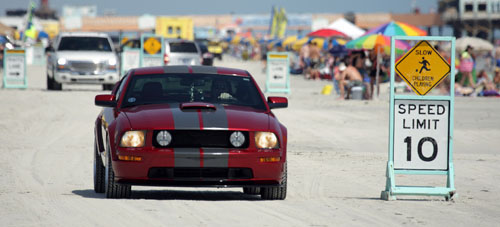
Driving on the beaches of the Daytona Beach and New Smyrna Beach areas is a Volusia County tradition dating dorsum to the early days of the automobile. For years, beachgoers have enjoyed a leisurely drive on the wide, hard-packed sands. Please be a responsible beach driver by driving merely in designated areas and observing the speed limit. The driving areas are designated by signs and wooden posts. Please lookout for pedestrians, sunbathers and wildlife. Parking is allowed eastward, or seaward, of the posts.
The beach is open to vehicles from 8:00 a.chiliad. and 7:00 p.m. or sundown whichever is earlier from May i through October 31, and between sunrise to sunset from Nov 1 to April 30, tides permitting. There is a twelvemonth-round $20 per day per vehicle access fee to bulldoze on the beach; this includes one same-day re-entry.
Beachgoers are encouraged to follow Volusia County Beaches on Facebook and Twitter for the latest beach information.
Beach Pass Holders Limited ramps
From March 1st through September, ane of Volusia County's vehicular access ramps is now a Pass Holders Express ramp and let entry to handicap vehicles and electric current annual pass holder vehicles only. This ramp is located at:
- Crawford Route in New Smyrna Embankment.
Beach passes
Annual beach passes are $25 for Volusia County residents and $100 for non-residents. For further information regarding embankment passes, please visit www.VolusiaBeachPass.com or telephone call the County's beach toll vendor, Faneuil, at (866) 398-6352.
The following fees and passes are bachelor at beach toll locations and the inlet parks.
- $20 daily embankment entry per vehicle (one free re-entry/mean solar day/same vehicle)
- $10 daily inlet park entry per vehicle at Lighthouse Point and Smyrna Dunes Park (one gratuitous re-entry/day/same vehicle)
- $25 resident almanac beach laissez passer (unlimited beach entry - 365 days from date of purchase)
- $20 annual inlet park pass (unlimited inlet parks entry - 365 days from date of purchase)
- $100 non-resident annual beach pass (unlimited embankment entry - 365 days from appointment of purchase)
- $45 resident combo pass (embankment and inlet parks unlimited entry - 365 days from date of purchase)
- $120 not-resident combo pass (beach and inlet parks unlimited entry - 365 days from date of purchase)
Steps to get a beach toll windshield sticker replacement.
i. Remove equally much as possible of the sticker and record the serial number on the front end of the sticker.
two. Turn in the sticker pieces to a beach toll berth or to the local part of the Canton's embankment price vendor, Faneuil, at 2422 S Atlantic Av, Daytona Embankment Shores, 32118.
The embankment is always open and free to pedestrians and bicyclists depending on tides and access ramps existence opened.
Volusia's beaches are divided into 3 experience zones -- Natural, Transitional and Urban. Natural beach zones exist from the North Peninsula State Recreation Area to Granada Boulevard in Ormond-by-the-Body of water, from Emilia Avenue in Daytona Embankment Shores to Embankment Street in Ponce Inlet, and from 27th Avenue in New Smyrna Beach to Canaveral National Seashore in Bethune Beach.
The Natural zones mostly stand for to the areas where off-beach evolution is less intense. The dune habitats within this area largely are intact. These areas besides have the highest concentration of turtle nests on Volusia beaches. Public driving and parking is not allowed in the Natural beach areas.
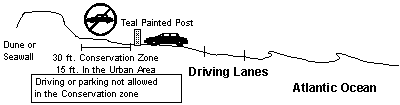
The Transitional zones are those areas which take a mixture of natural dunes and some beach seawalls. The concentration of people in these areas generally is less intense near of the year. Sea turtle nesting in these areas is moderate. Public driving and parking is immune in the Transitional zone thirty feet seaward of the dunes or seawall.
The Urban zones are those areas where off-embankment development includes hotels, loftier-rise condominiums and seawalls. The concentration of people is the about intense most of the year. Ocean turtle nesting in these areas is minimal. Public driving and parking is allowed in the Urban beach areas 15 anxiety seaward of the dunes or seawall.
Embankment parking
On the beach, parking is allowed east (seaward) of the conservation zone. Please park either facing the ocean or the dunes. Delight refer to the map for locations of off-beach parking areas.
More than 3,500 public parking spaces exist at numerous locations adjacent to and nearly the beaches.
Off-beach parking is offered at these parks and parking lots:
(additional parking fees may apply)
- Ormond-past-the Body of water: Bicentennial, N Shore and Tom Renick parks
- Ormond Beach: Andy Romano Beachfront Park
- Daytona Beach: Academy, 834 N. Atlantic Artery
- Daytona Beach: Sun Splash and Breakers Oceanfront parks
- Daytona Beach Shores: Frank Rendon, Van Avenue and Larry Fornari parks
- Wilbur-by-the-Sea: Heron Street, Toronita Avenue and Major Street
- Ponce Inlet: Winterhaven and Lighthouse Point parks and Inlet Harbor Road
- New Smyrna Beach: Smyrna Dunes, Flagler Avenue and 27th Artery parks; and Matthews Artery
- S of New Smyrna Beach: Bethune Beach Park
Marine life
Volusia County'southward world famous beaches attract millions of visitors each year. The sparkling, white sands of Daytona Beach and New Smyrna Beach offer a variety of environmentally friendly recreational experiences.
The beaches besides are home to hundreds of fascinating establish and animal species. Some animals, such as the loggerhead sea turtle and the pipage plover, are threatened with extinction. As a upshot, they are protected by land and federal laws. To preserve this cute natural resource for future generations of beachgoers, all of u.s.a. must work together to care for and protect this delicate beach ecosystem.
From May 1 through October. 31, Volusia beaches host an unusual marine company -- the ocean turtle. These magnificent animals emerge from the surf at nighttime to lay their eggs in nests dug into the dry sand, and so return to the sea. Two months afterward, well-nigh a hundred babe turtles or hatchlings sally from each of these nests and crawl to the ocean. This amazing cycle of Mother Nature is thousands of years old.
Volusia County has taken several steps to protect these gentle creatures. Embankment driving and parking is regulated. Vehicles are non immune west (landward) of the dune conservation zone where ocean turtle nests are most common. Dark driving and lighting from beachfront properties is restricted because the mother turtles and tiny hatchlings are dislocated by bright lights.
Source: https://www.volusia.org/services/public-protection/beach-safety/beach-driving-and-parking.stml
0 Response to "Daytona Beach Are Cars Allowed Again"
Postar um comentário